Aerial view of shoreline within the proposed Salmon Parks, a BC Conservation Fund supported project protecting and restoring expansive areas of forest habitat surrounding key salmon streams in Nootka Sound. Photo by T.J. Watt
The BC Conservation Fund, an initiative by BC Parks Foundation, conserves priority areas in BC that are ecologically and bioculturally diverse.
This may raise the question, what is biocultural diversity?
“Biocultural Diversity” is an important idea for conservation and environmental spaces…but what does it really mean? And why does it matter?
The term ‘biocultural diversity,’ coined by anthropologist, Dr. Luisa Maffi, explains the important link between culture and biodiversity. Alternatively, we can call it “diversity in all forms.”
Culture, language, knowledge, practices and protocols have been built around the environment – plants, animals, and landscapes that humans are surrounded by.1
“In the simplest terms [biocultural diversity is] acknowledging that humans are part of the environment,” Dr. David Zandvliet, explains.
David is a professor and researcher at Simon Fraser University, as well as the UNESCO Chair in Biocultural Diversity and Education.
“I've had a long history working in different Indigenous communities around the province,” David says, explaining one of his first teaching jobs was in Kitimat, BC. “Nothing in my teacher education prepared me to be working in Kitimat. I had to…reinvent how I taught when I was there.”
“I always viewed myself more as a facilitator, trying to connect Indigenous knowledge holders with teachers who will work in the informal and school-based education systems. It is important that they view Indigenous knowledge as important and relevant – and to see this idea also modelled by their professor.
David has also worked with communities in Yukon and throughout BC including Teslin, Cowichan Tribes on Vancouver Island, and has led a field school on Haida Gwaii for more than 20 years.
“As a settler, I've had a pretty untypical development as an academic,” David says. “I've always…taken what I would have called…a biocultural view of science.”
“[The ‘biocultural’ part of biocultural diversity] acknowledges that…[culture] in a place-based sense is good for environment,” he explains. “Because a culture helps to manage…the local conditions.”
David explains that in Indigenous communities there are often specific species and environmental conditions that are important to maintaining local cultures. “Because people have lived there… since time immemorial, and there have been…very complex interactions between the culture and the environment over time.”
Cultural burnings, that support and preserve wildlife is a great example of how cultural practices inform and manage local conditions.2
Other examples include traditional hunting or fishing practices that ensure no over-hunting or over-fishing, taking only what is needed, so that a species population can be maintained or grow.
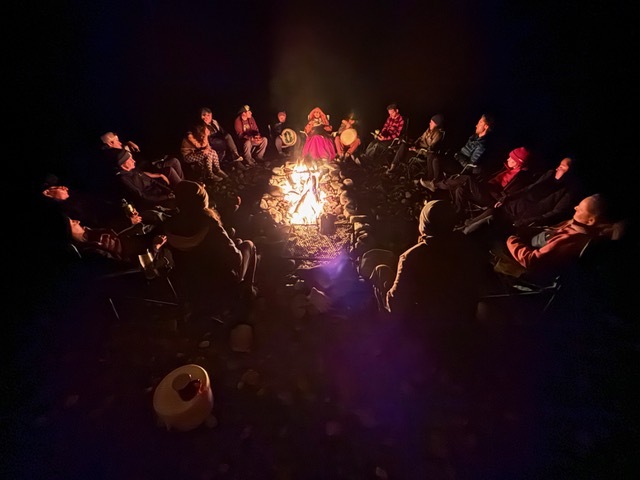
“There are studies that show that in Northern BC …where Indigenous communities traditionally lived, these are now some of the most biodiverse parts of the province.”
Supporting Indigenous based conservation is an integral step forward, and the BC Conservation Fund recognizes and promotes First Nations leadership and governance or co-governance in conservation and stewardship. Fund supported area-based projects are either led or supported by First Nations communities, and aim to secure protection designation under First Nation law alongside provincial law as a key outcome of government-to-government planning and negotiations.
“I guess it belies the myth of wild,” David observes. “This idea that, ‘oh, BC is a wild place?’ Well, no, a lot of the diversity that we see in British Columbia was actually curated by Indigenous communities over time.”
“The cultures arose out of local environments, but these environments also arise (and are maintained by local cultures.”
In the past, conservation efforts have been separated from the preservation of cultural heritage3, but over the past decades it’s become clear that culture informs and protects biodiversity, and that to continually conserve nature, culture and biodiversity must go hand in hand.
Currently, 34 conservation initiatives and 15 biodiverse area initiatives are being supported by the BC Conservation Fund. Within these projects there are 238 partners working together across governments, non-profits, universities, businesses, and 81 First Nations communities which are leading or supporting in these conservation efforts.
“If the most biodiverse places in the province are the ones that were managed by Indigenous communities, there's a message there, right?”
“Supporting [Biocultural diversity] is not something you talk about,” David concludes. “This is something you do. You have to model it. Nobody believes what you talk about. They believe what you do.”
References: